Amy Neftzger, author, researcher, and drummer writes about whatever she wants on this blog. She is internationally published in both fiction and nonfiction. For more information, please visit her website at amyneftzger.com
Welcome to whatever is on my mind!
Some people use the term "nonsense" but I prefer to use the phrase "uncommonly sensed" because it's more reflective of creative types.
Showing posts with label authors. Show all posts
Monday, October 17, 2016
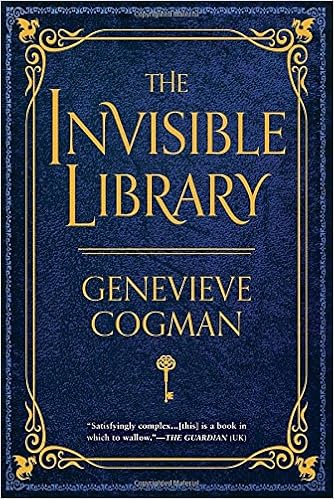
Genevieve Cogman's Invisible Library
Genevieve Cogman is the author of The Invisible Library fantasy book series for young adults. A few months ago I received an advance review copy of the first book from the publisher and I enjoyed the story very much. The second book in this series have now been released and I’m looking forward to reading it. What I enjoyed most about the first book was the concept of a hidden library hat contains versions of books from alternate universes. The thought that there could be hundreds or thousands of versions of our favorite stories is appealing to a reader such as myself. Aside from the incredible library, what caught my attention in her writing were the strong characters and action sequences - something we don’t typically associate with a book about books. This is truly an adventure novel that keeps moving. I had an opportunity to interview Genevieve and here are her responses to some of my questions.
Q: You’ve written some strong female characters in this book. Can you describe what inspired each of these (Irene, Coppelia, and Bradamant) characters?
A: I’m not sure any of them have a single point of inspiration. Irene is the standard protagonist who just wants to get on with the job, and finds herself with too many things to juggle at once. She’s also a thorough bookworm and daydreamer (which is why she picked the name “Irene”, after all) and a competent operative, a little bit Modesty Blaise though also a lot of Moneypenny.
Coppelia’s the mentor who knows more than she’s prepared to admit, a Librarian with a lot of history (such as why she’s got a mechanical arm) and her own personal tastes in literature. (For the record, she likes science fiction, particularly books about artificial intelligence.)
And Bradamant’s the rival who has a past history with the protagonist, and whose methods and morality are different enough that they come into conflict about how to achieve their goals, though they end up working together. She’s a person whose first argument is always “the ends justify the means”, and who sees herself as a misunderstood hard worker who makes the hard choices which nobody else will commit to.
I think that ultimately any of them could have been male or female. First and foremost, they’re people.
Q: What sort of research did you do in preparation for (or during) the writing of these books?
A: I did quite a lot of investigation on the internet into things like the geography of London, famous missing or never-written books, the British Museum and the British Library, and how to spell Liechtenstein. I also read and reread my collected Sherlock Holmes stories by Sir Arthur Conan Doyle to try and get the vocal patterns and habits correct. And for the action scenes, I watched quite a lot of Hong Kong action movies (a long-term addiction of mine).
Q: What scenes were the easiest to write (and why)? Were any scenes difficult?
A: I think the hardest scene to write may have been the one where Irene is explaining about the Library to Vale, because I was trying to convey quite a lot of information, but I didn’t want the scene to get boring or slow down too much. I’m not sure that I can say any scene or scenes was the “easiest”. They all took work.
Q: What authors do you enjoy reading (and what do you like about their work)?
A: I don’t want to give you a list of several dozen authors (which would barely be scratching the surface), so I’ll try to think of a few favourites. Lois McMaster Bujold, Kage Baker, Naomi Novik, Terry Pratchett, Ben Aaronovitch, Paul Cornell, Tamora Pierce, Diane Duane, Steven Brust, Charles Stross, Barbara Hambly, Pat Mills, GK Chesterton, JRR Tolkien, Mary Renault, John Dickson Carr, JK Rowling, John M Ford, Barry Hughart... I find a wide spectrum of things in their writing, including interesting characters, well-handled narrative, good description, brilliant dialogue, imaginative concepts, and stories which sweep you along once you get into them and make it hard to stop reading. I want to read different things at different times. Sometimes I really want a book that makes me think (like John M Ford or Mary Renault), and sometimes I just want something which I can settle into and enjoy.
Q: If you’ve ever read a book more than once, please give the name of the book and explain why you chose to re-read it.
A: If I’ve read a book once and enjoyed it, then I’m almost certainly going to read it again at some point. (There’s a reason why my flat is overfull of books...) I’m afraid the answer to this question is “far too many to count”, and “because I enjoyed reading it the first time”. I’m a very fast reader.
Q: What are the top 3 items on your bucket list?
A: At the moment:
See a live performance of the musical Elisabeth.
See a production by the Takarazuka Revue while in Japan (this includes going to Japan!)
Visit Hong Kong.
Q: Tell me about your favorite things: favorite travel location, favorite food, favorite drink, favorite activity, favorite museum, favorite library(ies), favorite book, favorite movie, and favorite band or song.
A: Bearing in mind that all these are my current favourites, and may change in the future if I come across something new which I like better:
Favorite travel location - Venice
Favorite food – Chicken liver risotto (my father’s recipe)
Favorite drink - Coffee
Favorite activity - Reading
Favorite museum – I used to love going to the Geological Museum in London, though I haven’t been there for ages.
Favorite library(ies) – No particular favourite, they’re all valued.
Favorite book – Journey to the West, by Wu Cheng’en
Favorite movie – Brotherhood of the Wolf
Favorite band or song – Pardonne-moi, by Mylene Farmer
Q: What are you working on now?
A: I’m currently working on book 4 of the Invisible Library series. No rest for the wicked...
Find out more about Genevieve Cogman:
Author Website
Author on Goodreads
Enter The Invisible Library sweepstakes
The Invisible Library on Amazon
The Masked City on Amazon
https://www.amazon.com/dp/1101988665/
Thursday, February 12, 2015
The Sound Of The Author's Voice
I’ve been to readings and talks given by writers such as Margaret Atwood, Neil Gaiman, and Malcolm Gladwell. Author events aren’t a new phenomena - these have been popular for decades. In fact, I’ve read that Charles Dickens was one of the first author celebrities and did speaking tours that were highly attended. The book that discussed this topic also mentioned that prior to Dickens most authors had few public events or speaking engagements. It just wasn’t a “thing.”
Recently I’ve come across a number of videos and recordings of authors who have passed away. I’ve enjoyed hearing these authors read their works or catching a glimpse of their personalities through their speaking patterns. What’s often interesting for me is how sometimes the sound of an author’s voice or their speech patterns don’t match what I had imagined.
It’s been fun to get to know some of these authors through video or audio clips.
Here are a few that I like:
Recently I’ve come across a number of videos and recordings of authors who have passed away. I’ve enjoyed hearing these authors read their works or catching a glimpse of their personalities through their speaking patterns. What’s often interesting for me is how sometimes the sound of an author’s voice or their speech patterns don’t match what I had imagined.
It’s been fun to get to know some of these authors through video or audio clips.
Here are a few that I like:
Virginia Woolf
Ernest Hemingway
David Foster Wallace
Roald Dahl
And here's an audio recording of Sylvia Plath reading her poem Tulips.
Try doing a YouTube or Internet search for some of your favorite authors
and see if you can find any recordings. But don’t forget - the written
word has been around for thousands of years, while sound recordings are
just over 100 years old. So you won’t find recordings of authors who
weren’t alive during the past 120 years. Enjoy discovering new ways to connect with some of your favorite authors!
Thursday, February 20, 2014
On Negative Reviews
Very few people are familiar with the name of Rufus Griswold. On the other hand, there are also very few people who don’t know the name Edgar Allan Poe. The irony is that much of what the average person “knows” about Poe was written by Griswold and these fictions, which appear to have been intended to harm Poe’s reputation and destroy his literary legacy, only served to increase Poe’s popularity. The dark descriptions Griswold wrote about Poe being an individual of poor character actually drew more interest in Poe’s work. This strategy of slander backfired and today most people know Poe’s name and literary work while Griswold is all but forgotten.
Certainly, there are a lot of mysteries surrounding Poe and his death, but the biography Griswold wrote adds another layer of darkness that further obscures the truth. In fact, we can’t even be certain that Poe would disapprove of the false accusations, given how much it has brought attention to his own work. However, it brings to mind some of the reviews that I’ve seen authors giving other authors on retail and book related sites. It’s not uncommon for some authors to give low ratings or write unfavorable reviews for books that may compete with their own books for readers or market share.
Like most literature enthusiasts, I enjoy some books more than others. However, if I read a book that I don’t like, I simply don’t review it. Just because a book doesn't appeal to me doesn't mean that it was a bad book. In fact, more often than not, the reason I don’t enjoy a book is because it’s not relevant to me at the point in my life in which I read it. That doesn’t mean that the book would never be relevant or didn’t have the potential to take on meaning for me at a different point in my life. A reader’s experience is subjective and may be completely irrelevant to the quality of a book. Therefore, it’s important to explain why a book appealed to you in a positive review and carefully choose your words if you decide to write a negative review. But even well written negative reviews can reflect poorly on the reviewer.
Negative reviews often tell you more about the reviewer than the book being reviewed. Dislike for something that is strong enough for a reviewer to take the time to record it publicly tells you what’s important to the reviewer or where the reviewer struggles. Negative reviews are also frequently emotionally charged, thereby giving hints to the reviewer’s real issues. These are often unrelated to the book and more likely related to the subject matter or something about the author that reminds the reviewer of someone else. In the case of Griswold and Poe, Griswold’s real issue appears to be one of jealousy.
This brings about another important issue of authors writing negative reviews of another author’s work. Remember that your criticism isn’t simply evaluating the author’s writing: it is actually far more critical of the publisher’s and editor’s work. It’s the editors who determine if a book is well written enough to be published and who are also responsible for catching many of the issues that you may be criticizing. I’ve spoken with more than one editor who has said that they refuse to work with authors who write scathing reviews of other authors’ works because they feel that these individuals tend to have difficult personalities. So before writing a negative review, think twice about how it may reflect upon you. You could hurt your own chances of eventually getting published because, as one editor put it: “No one wants to work with a know it all, and people who constantly criticize others give the impression that they think they know everything. I don’t have time to deal with someone like that.”
Today when I read strongly negative reviews I’m often reminded of Poe and think, “something that evokes so much hatred must be worth reading.” Hatred isn’t a neutral reaction. In fact, some people argue that hatred is not the opposite of love and that indifference would be the true contrasting reaction. More often than not, truly bad books are simply ignored by the reading public because they aren’t recommended. It stands to reason that if someone takes the time to write a negative review in order to deter others from reading the book, that it was done for a reason.
Hatred is counterproductive on so many levels, and allowing your disdain for someone else’s writing could cause you to lose readers. Most people feel that individuals who need to push others down in order to lift themselves up probably don’t need to be elevated at all because they’re not demonstrating that they have anything worthwhile to say. After all, the main purpose of writing is to say something that’s worth reading. So instead of writing negative reviews, try expressing appreciation for the work of others that you do enjoy. This can help you to gain a larger audience because potential readers will better understand your work by the literary company you keep.
Certainly, there are a lot of mysteries surrounding Poe and his death, but the biography Griswold wrote adds another layer of darkness that further obscures the truth. In fact, we can’t even be certain that Poe would disapprove of the false accusations, given how much it has brought attention to his own work. However, it brings to mind some of the reviews that I’ve seen authors giving other authors on retail and book related sites. It’s not uncommon for some authors to give low ratings or write unfavorable reviews for books that may compete with their own books for readers or market share.
Like most literature enthusiasts, I enjoy some books more than others. However, if I read a book that I don’t like, I simply don’t review it. Just because a book doesn't appeal to me doesn't mean that it was a bad book. In fact, more often than not, the reason I don’t enjoy a book is because it’s not relevant to me at the point in my life in which I read it. That doesn’t mean that the book would never be relevant or didn’t have the potential to take on meaning for me at a different point in my life. A reader’s experience is subjective and may be completely irrelevant to the quality of a book. Therefore, it’s important to explain why a book appealed to you in a positive review and carefully choose your words if you decide to write a negative review. But even well written negative reviews can reflect poorly on the reviewer.
Negative reviews often tell you more about the reviewer than the book being reviewed. Dislike for something that is strong enough for a reviewer to take the time to record it publicly tells you what’s important to the reviewer or where the reviewer struggles. Negative reviews are also frequently emotionally charged, thereby giving hints to the reviewer’s real issues. These are often unrelated to the book and more likely related to the subject matter or something about the author that reminds the reviewer of someone else. In the case of Griswold and Poe, Griswold’s real issue appears to be one of jealousy.
This brings about another important issue of authors writing negative reviews of another author’s work. Remember that your criticism isn’t simply evaluating the author’s writing: it is actually far more critical of the publisher’s and editor’s work. It’s the editors who determine if a book is well written enough to be published and who are also responsible for catching many of the issues that you may be criticizing. I’ve spoken with more than one editor who has said that they refuse to work with authors who write scathing reviews of other authors’ works because they feel that these individuals tend to have difficult personalities. So before writing a negative review, think twice about how it may reflect upon you. You could hurt your own chances of eventually getting published because, as one editor put it: “No one wants to work with a know it all, and people who constantly criticize others give the impression that they think they know everything. I don’t have time to deal with someone like that.”
Today when I read strongly negative reviews I’m often reminded of Poe and think, “something that evokes so much hatred must be worth reading.” Hatred isn’t a neutral reaction. In fact, some people argue that hatred is not the opposite of love and that indifference would be the true contrasting reaction. More often than not, truly bad books are simply ignored by the reading public because they aren’t recommended. It stands to reason that if someone takes the time to write a negative review in order to deter others from reading the book, that it was done for a reason.
Hatred is counterproductive on so many levels, and allowing your disdain for someone else’s writing could cause you to lose readers. Most people feel that individuals who need to push others down in order to lift themselves up probably don’t need to be elevated at all because they’re not demonstrating that they have anything worthwhile to say. After all, the main purpose of writing is to say something that’s worth reading. So instead of writing negative reviews, try expressing appreciation for the work of others that you do enjoy. This can help you to gain a larger audience because potential readers will better understand your work by the literary company you keep.
Labels:
authors,
book review,
books,
Edgar Allan Poe,
writers,
writing
Thursday, January 17, 2013
Don't Fear the Reading
I recently attended an event where I heard one of the speakers say that he didn’t read any fiction books if he didn’t like the author’s message. I realize that we all have different reasons for why we read the things we read, but I lose respect for people who tell me they don’t read a particular author because they disagree with the message.
One of the key issues with this statement is that there is no way to know an author’s message until you’ve read the book. So there’s an underlying issue that this individual doesn’t want to listen to viewpoints different from his own. If his primary desire is to be closed minded, then why is he reading at all? Reading opens up worlds. If your desire is to enclose your world as much as possible, then opening a book is the wrong place to go.
Just because an author has different religious or political beliefs doesn’t mean that the author can’t tell a story or has nothing valuable to say. If the author views the world differently, it can get us thinking about our own views in a way that strengthens and refines them. This is a good thing.
The Murakami quote in the meme at the top of this post is one of my favorites. Reading stretches the mind and opens up worlds. Reading books from different perspectives is an artistic dialog between the author and reader. No one has to be right or wrong. It’s really about the conversation. And the more we converse, the more potential we have to make the world we live in a better pace.
So don't be afraid to read about different perspectives. You may even discover new things about yourself.
Subscribe to:
Posts (Atom)

